Tuesday, December 10, 2013

Christmas Tradition of Caroling

     One of my favorite Christmas traditions is singing Christmas carols. I realize not everyone celebrates Christmas, but what I have to share is primarily about the joy of the season. My mother is a singer; she sang with the Mormon Tabernacle Choir for seven years. Growing up, she would gather her children around the piano to sing. At Christmas time, she would bake cookies and give plates of them to friends and neighbors. We would go with her to deliver them, and sing a few carols to each recipient. One of our neighbors enjoyed this tradition so much that, even after moving away had us telephone them each year to hear us sing carols. I am not saying we were as good as the Osmond family (though that was my mother’s dream), but we loved sharing the joy of the Christmas season.
     I spent Christmas 2011 in Afghanistan. The Canadian junior officers invited me to participate in their tradition of caroling to the senior officers and others of the staff. For me, this made Christmas wonderful, despite being apart from my family. Whatever traditions you observe this holiday season, may you find the joy that comes only through giving.

Wednesday, March 21, 2012

A few pictures from end of the deployment

To be honest, uploading pictures on a slow internet connection was burdensome at times. Now that I am back home and have fast internet again, here are a few pictures from the end of the deployment.

Shannon, Ireland at the airport

On the way to Camp Blackhorse

At Kabul International Airport: time to go home!

No Tanks!

At the Religious and Cultural Affairs School

David Ness from Norway, a faithful artist at the Saturday night Painting Class!

Swanie (Australian Defence Force) gave me this slouch hat as a gift.

Mountains in Kabul

More mountains in Kabul

SGT Thomas (Australian Defence Force) and CPT Hale at Camp Alamo

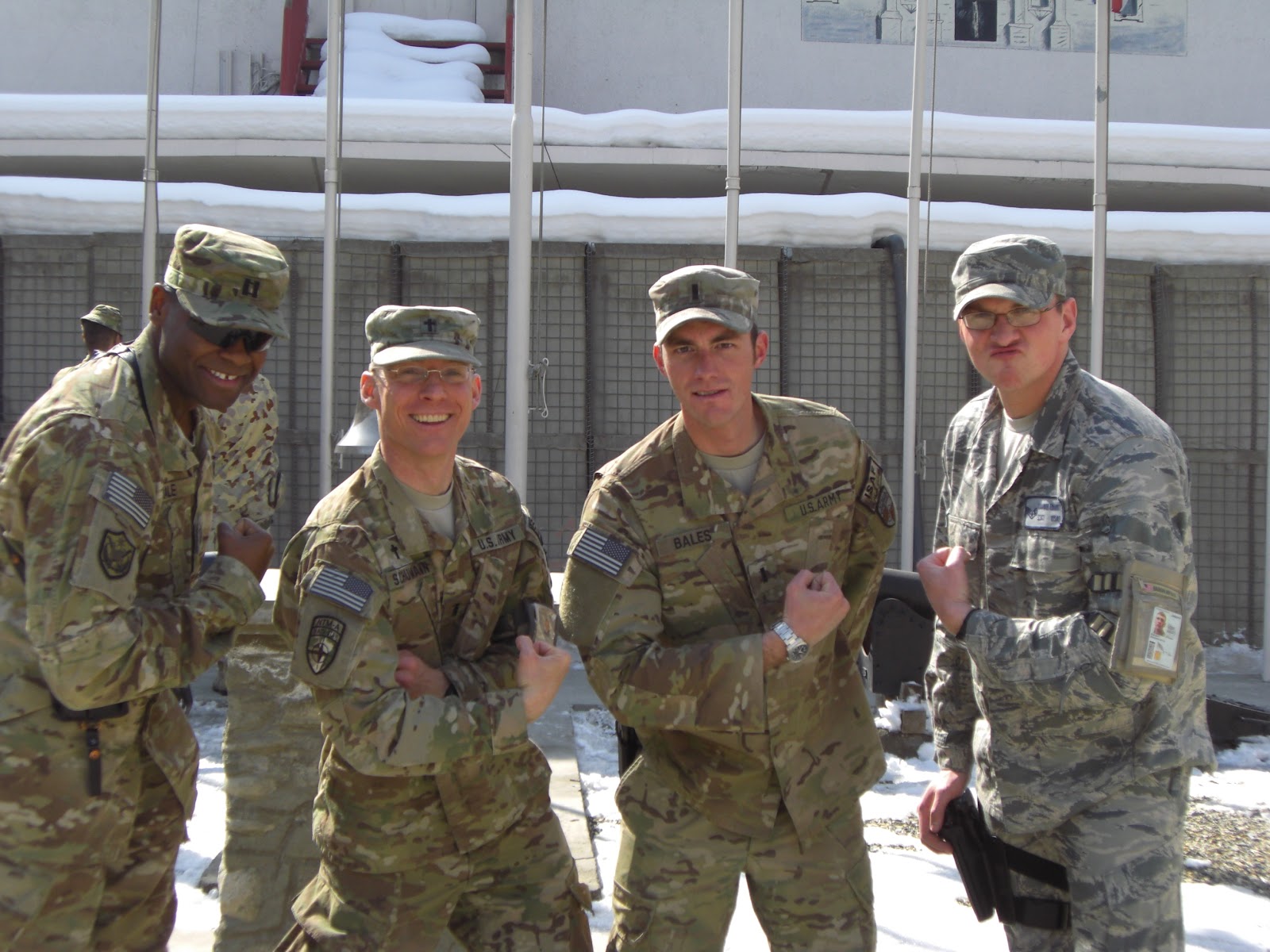
Gettin' huge! CPT Hale, me, 1LT Bales, SGT Earhart

Me and SGT Thomas (Thommo)

Home

     It feels good to be home. I got back last Thursday. We flew from Afghanistan to Kyrgyzstan (2 hour flight) and stayed there a few days. Then we flew about 7 hours to Shannon, Ireland. I was overwhelmed with how green Ireland was, even from the airport. We rarely saw that kind of green in our part of Afghanistan. It was dry and arid, though we did get a hefty amount of snow in January and February. From Ireland we flew to Fort Dix, New Jersey, where we out-processed for a week. Passing through all of the medical and administrative checks was quite the undertaking. I could have stayed an extra week to get my knee checked out, but chose to get the medical care here in Minnesota. When I arrived at the airport, Emily and Josiah greeted me. Emily brought an OCP hat and put Josiah in it so we would match for pictures. I wondered if Josiah would feel weird around me, but he had no problem letting me hold him. I think skyping on a daily basis really helped. We were very fortunate in that regard; we had ready access to computers and so were able to touch base with family nearly everyday.
     Here at home I am enjoying the simple pleasures of family. I love just holding my son, Josiah, and kissing his fat little cheeks. I love listening to him laugh. Tonight, Emily and I took him to the pet store. He went nuts looking a the little puppies and fish; he is so full of energy. Emily really got things ready for my return. She even unpacked all the boxes that I had shipped home, and had a place for me to put my things like wallet and keys. She surprised me with Josiah now being in his own room, and he really likes it. She did a marvelous job with his room; it looks great! Even though we are in an apartment; we are quite happy here. We have all the room we need, and Emily has done a fantastic job of getting things organized and on top of that it looks great--she has been very busy.
     I have spent some time applying to Clinical Pastoral Education residencies; we will see what happens. It is nice to have some time to reconnect and to get situated before going back to work. The weather has been fabulous, unseasonably warm, and beautifully cool yesterday and today. Hard to believe that whole year-long deployment is over. I was blessed with a great advising assignment and am grateful for friends I made and experiences that I had. Josiah tried on his little Afghan vest and hat--they fit perfectly. One of my friends in the Afghan National Army gave them as a gift. I miss my friends there.
     Emily is making brownies....yum!

Sunday, March 4, 2012

Recently

Celebrating the Lunar New Year as special guests of the Mongolian Artillery Training Team


Father Abraham

            In the scriptures we sometimes encounter the terms “milk” and “meat,” relative to how challenging certain doctrines of the Gospel are. I would like to talk about something that I feel is “meat.” We do not use this topic to introduce people to the Restored Gospel of Jesus Christ; it comes later as people “grow in grace and in the knowledge of our Lord and Saviour Jesus Christ” (2 Peter 3:18; John 17:3). That said, I will not digress into speculation; I will hold to the words of revealed scripture. 
           In the region that we labor, Abraham is honored and revered. He is the common heritage shared by Judaism, Christianity, and Islam. From a Latter-Day perspective, I would like to address how God prepared Abraham to be a god himself. We cannot apologize for this doctrine of eternal progression;  it is at the root of all that we believe. Many misunderstand this doctrine, thinking that we demean God. In response to one such misunderstanding concerning the divinity of Christ, I replied: “The LDS Church does not seek to bring Christ down to our level; it only declares that God is able to bring us up to his. With God, all things are possible. We will never be equal with God; he is eternally progressing just as we are. Yet, we do not believe that we will remain at the same level for eternity; we will progress because of the merciful Atonement of Jesus Christ.” Indeed, through the lineage of Abraham would come the Redeemer of all mankind, to relieve suffering and deliver us from the sins of this world.
            Suffering is part of this mortal existence, and it prepares us to be like God. Isaiah referred to Christ, our advocate with the Father, as a “man of sorrows and acquainted with grief” (Isaiah 53:3). When Adam and Eve were cast out of the Garden of Eden, they were told that they would bear children and labor for bread “in sorrow” (Genesis 3:16-17). Abraham was no stranger to sorrow and suffering. After marrying Sarai, there was a famine in the land that drove him to Egypt, where he almost lost Sarai to the Pharaoh because of her beauty. God promised Abraham numberless posterity, yet Sarai was barren. How many decades passed while this promise remained a distant hope? Abram was 75 when God commanded him to leave Haran and go to the land of Canaan. He was 86 years old when Ishmael was born of Hagar. He was 100 years old when Isaac was born of Sarah. It is likely that at least four decades passed while Abraham and Sarah waited for children of their own. (Could this be why Lot, his nephew, lived with Abraham and Sarah, to ease the pain of their childless state?)
            After decades of waiting, Isaac was born to Sarah, fulfilling the promise of God. What joy this must have brought to their home! Now that he had come, would Abraham be willing to offer him as a sacrifice, to be obedient to God’s commandment? How this must have tormented Abraham! How could he give up his only son (of Sarah)? Was he willing to be like God, to give up his only son, the son of the promise? Abraham’s response revealed that he was. In Abraham’s willingness, God provided redemption. For Abraham, there was a ram in the thicket, and his son lived, fulfilling the promise of endless posterity. For God, his Son was resurrected and now lives forever, offering eternal salvation to all of God’s endless posterity.
             In the Bible Dictionary, we read that Abram means “exalted father.” Insert “ha,” and his name becomes, “Father of a multitude.” This may be simply coincidental, but in Dari, one of the primary languages of Afghanistan, the sound ha, when added to a word, makes it plural. The Hebrew word, El, denotes “might, strength…the divine being.” Elohim is “a plural form signifying the ‘almighty’ or ‘omnipotent,’ a name applied to the Father” (LDS Bible Dictionary, https://www.lds.org/scriptures/bd/el.p1?lang=eng&letter=e). God is plural, having numberless posterity, and his name denotes such. In Abram becoming Abraham, we see the pattern of godhood carried out.
             In our mortal state we are confined to knowing only our own heart and mind. Yet as we draw closer to God, “we have the mind of Christ” and through the atonement will one day become omnipotent, knowing the hearts and minds of all our children (1 Corinthians 2:16, John 17:3). We will, in essence, transcend the self, as referred to by Victor Frankl in his book, Man’s Search for Meaning and “be gods, because [we] have no end” (Doctrine and Covenants 132:20). Abraham transcended the self to receive exaltation. In this journey, Abraham experienced war, famine, waiting, and anguish. Through it all he displayed great faith, and thus it was “counted to him for righteousness” (Romans 4:3). “Abraham received all things, whatsoever he received, by revelation and commandment, by my word, saith the Lord, and hath entered into his exaltation and sitteth upon his throne” (Doctrine and Covenants 132:29). To be clear, we do not and will never worship Abraham; we will only worship God. Yet, we can look to Abraham as an example of one who “overcame…by the blood of the Lamb” and received all that the Father hath (Revelation 12:11; Doctrine and Covenants 84:38). The fullness of the Gospel of Jesus Christ is thus to do as Abraham did, to become like God through the Atonement of his Son. Indeed, it is into the covenant that God made with Abraham that we must enter to gain eternal life as God has. That we may do this is my prayer, in the name of Jesus Christ, amen.

Sunday, February 5, 2012

A couple pictures

SGT Schmid, CH Hester, me (2011)
This was a visit to the "Hall of Heroes" atop a hill in the Kabul area.


me, SGT Thomas, Padre Simmonds (2012)
Padre Simmonds, a chaplain from Australia, came and preached during one of our Protestant services. SGT Thomas is working towards becoming a chaplain and has been a dear friend on this deployment.

The Fifth Commandment


The Fifth Commandment

            The fifth commandment that God gave to Moses on Mount Sinai, declares: “Honour thy father and thy mother: that thy days may be long upon the land which the Lord thy God giveth thee” (Ex 20:12). Though this seems to be a commandment directed primarily at children, it concerns the family, and therefore has relevance for parents as well.
            As parents, let us remember two things in pondering the fifth commandment:
  1. No matter what our children do, never give up hope.
  2. As God is our father, honoring him will bless our children. Trust that our obedience to God’s commandments will ultimately bless our children as promised in the commandment.
            By way of illustration, let us consider Lehi’s family in how they did or did not adhere to the Fifth Commandment. Laman and Lemuel did not keep it. Murmuring against one’s parents brings them no honor. What was Lehi’s response to their disobedient and rebellious spirit? (Keep in mind that their actions endangered family lives on multiple occasions, and during the ocean voyage to the Promised Land, Laman and Lemuel’s failure to keep this commandment carried with it potentially dire consequences for all.) Lehi responded thus:

And he did exhort them then with all the feeling of a tender parent, that they would hearken to his words, that perhaps the Lord would be merciful to them, and not cast them off; yea, my father did preach unto them. And after he had preached unto them, and also prophesied unto them of many things, he bade them to keep the commandments of the Lord; and he did cease speaking unto them (1 Nephi 8:37-38).

            Ponder this thought with me (concerning 1 Nephi 2): if Laman and Lemuel, whose seed would eventually destroy Nephi’s seed, wanted to stay in Jerusalem, why didn’t Lehi just let them stay? Wouldn’t that avoid a lot of war, death, and conflict? What of the peace and harmony in the family at the time of their departure from Jerusalem? What if Lehi had approached God in prayer for permission to leave behind his two eldest sons? They had their free agency, right?
            On the surface, leaving behind Laman and Lemuel might seem to make preemptive sense. In a few years they would be divided by war anyway; why not just make it official now? After we have finished our attempt to counsel the Lord in a way Lehi did not dare, we remember why this was not right. Angry citizens of Jerusalem sought Lehi’s life. Therefore, for operational security, Lehi’s sons could not remain behind, just as Zoram, the servant of Laban, could not remain behind once he had even remote knowledge of the intentions and whereabouts of Lehi’s family. Secrecy meant safety. Additionally, had they stayed behind, Laman and Lemuel would likely be subject to shame and ridicule because of who their father was; to now be separated from him might only compound the problem. They were near the age of marriage, but likely not past it, so they were not yet independent from their family. How could they seek marriages for themselves? This would go against the customs of the day, that parents arranged marriages for their children. Remember that they approached Ishmael and his family under the direction of their father, Lehi. They could not simply seek the daughters of Ishmael without his guidance. No, they could not stay in Jerusalem without their family.
            Setting aside the reasoning of men, let us consider the real reasons Lehi could not leave his sons in a city destined for captivity and destruction. First, he loved his sons. He knew of their rebellious tendencies, but did not give up hope. At the other end of Book of Mormon history, Mormon wrote to his son, Moroni, concerning the ministry among the unrepentant Nephites. Though his own people would not listen and were on the eve of destruction, Mormon would not abdicate his divine responsibility to call them to repentance.

And now, my beloved son, notwithstanding their hardness, let us labor diligently; for if we should cease to labor, we should be brought under condemnation; for we have  a labor to perform whilst in this tabernacle of clay, that we may conquer the enemy of all righteousness, and rest our souls in the kingdom of God (Mormon 9:6).

If there was ever a time where missionary work seemed futile, it would be during the last days of the Nephites. In the movie, Return of the King, King Théoden despaired as it seemed his people would be overrun by the forces of evil: “what can men do against such reckless hate?” (J.R.R. Tolkien). Yet, Aragorn, king in embryo, would not give way to hopelessness. Staring death in the face, he rallied the king: “ride out with me!” If they were to perish, it would not be in abdication of their duty, but in devotion to it. No blow struck against evil is wasted. Mormon knew this, and he needed to remain in this vigilant spirit to strengthen his son, Moroni, who would bear the heavy responsibility for finishing and hiding the sacred records in the earth. He wrote several epistles to his son to this end.
            Giving in to hopelessness sets in motion a domino effect. What if Mormon had given in? “Why should I declare the word of God if no one will listen? If we who are the primary record keepers are to perish, why am I bothering with this cumbersome set of metal plates? The Lamanites will eventually find them anyway and just melt them down. Carrying them is just slowing me down. God knows my heart, and that what I do will not change the current situation. Is not all this just a waste of time? All is lost.” The prayers of generations of prophets in the western hemisphere rested squarely on his shoulders. Giving up would have run counter to all thir petitions to God.
            Let us give thanks that Mormon did not lose hope. He trusted in God and his eternal purposes. Were there among the Nephite armies, young warriors whose parents had set them against the things of God? Though they would soon perish in battle, would Mormon’s words soften their hearts in preparation for hearing the Gospel of Christ in the spirit world? Did not Christ break the bands of death so that it was merely a passing and no longer an obstacle? Alma tells us that “all is as one day with God, and time only is measured unto men” (Alma 40:8). Any blow for good lessens the power of Satan on this earth and in the life to come, no matter how hopeless the current situation seems. Alma records of Captain Moroni that, “If all men had been, and were, and ever would be, like unto Moroni, behold, the very powers of hell would have been shaken forever; yea, the devil would never have power over the hearts of the children of men” (Alma 48:17). Our righteous acts have far-reaching, eternal consequences. Through the merciful Spirit of God, our vision can be extended just enough to give us courage to do our duty in the midst of seemingly hopeless situations.
            Lehi did not despair; he took his whole family, wayward sons and all, into the wilderness. He loved his sons and could therefore not give up hope. Even after his vision of the Tree of Life, where he witnessed Laman and Lemuel’s refusal to partake of the love of God, Lehi did not give up. He loved his sons.
            Because Lehi truly loved Laman and Lemuel, he was obedient unto the commandment of the Lord. Despite their murmuring, he did not give in to their desires to stay in Jerusalem against the commandment of God. He did not honor his sons more than he honored his Father in Heaven. Think back to Eli, the priest in the Old Testament. He was a good man, a godly man who served faithfully in the house of the Lord. He helped to mentor young Samuel, who would later become prophet in Israel. Yet, as faithful as Eli was, he fell short in his parental responsibilities. His two sons, Hophni and Phineas, who were also priests in the Tabernacle, were serving unworthily (1 Sam 2:12-17, 22, KJV). They had selfishly perverted the sacrifices people brought to the Tabernacle. They also “slept with the women who served at the entrance” to the Tabernacle (1 Sam 2:22, NIV).  The seriousness of their transgressions had far-reaching consequences for Israel. Because of their wickedness, people did not want to come to worship at the Tabernacle.
            After hearing of his sons’ iniquities from other people, Eli reproved his sons, but did not do enough to check them in their evil ways (1 Sam 2:23-25). He honored his sons more than God. Why had he allowed their sins to go on for so long? Scripture records that he did nothing about it until he heard about their deeds from “all the people” (1 Sam 2:23). Why was Eli so slow to discipline his sons? Did he fear their reaction to his rebuke more than God? Because of his neglect in disciplining his sons, he lost blessings, and his short-sightedness brought long-term consequences. A man of God prophesied concerning his posterity: “all the increase of thine house shall die in the flower of their age.”
            Compare this curse to the final blessing Lehi gave Laman and Lemuel. Despite their disobedience, he declared, “because of my blessing the Lord God will not suffer that ye shall perish; wherefore, he will be merciful unto you and unto your seed forever” (1 Nephi 4:7). What a contrast! What was the difference between Lehi’s family and Eli’s family? Both had sons who were rebellious, and both reproved their sons. A closer look reveals that Lehi reproved his sons as soon as they started murmuring (1 Nephi 2:11-12); he did not wait to correct them until they had committed heinous sins. He admonished Laman to “run into the fountain of all righteousness” and Lemuel to “be “firm and steadfast, and immovable in keeping the commandments of the Lord!” (1 Nephi 2:8-9). On the other hand, Eli waited until his sons’ untoward reputation had spread through all Israel, adversely affecting the worship of the people. By then it was too late and Eli’s house would be cut off.
            Imagine if Lehi had given in to Laman and Lemuel’s wishes. Think about Lehi’s potential rationalizations concerning his sons: “Leaving home would upset them and God would not want them to be upset, right? My sons are not ready to leave yet; we will just leave a little later. It is not as bad here in Jerusalem as I thought; maybe we should stay and help turn things around. After all, I shouldn’t judge these people; I should do what I can to help them.” Any one of the above rationalizations would have spelled doom for Lehi and his family. Each of the above lacks the key ingredient of simple, trusting obedience. Yet, Lehi showed us that anything short of exact obedience is not obedience.
            Lehi trusted God and was obedient, and therefore helped preserve God’s blessings for Laman and Lemuel by bringing them to the land of Promise, (kicking and screaming). Even though they did not honor their father and mother, their posterity were ultimately blessed because of Lehi’s obedience to God’s command, which was to take himself and “his family and depart into the wilderness,” (1 Nephi 2:2-3). Lehi honored his Father in Heaven.
            With the benefit of hindsight we realize that the seed of Laman and Lemuel were destined to be a scourge to the seed of Nephi in the Promised Land. This was similar to the neighboring tribes fighting with Israel to stir them up in remembrance of the Lord their God. Additionally, as promised by Lehi, Laman and Lemuel’s posterity would be blessed despite the their sins. Would these blessings take a while to manifest in earthly time? Certainly. Yet, millennia later, the Lamanites in South and Central America are “blossom[ing] as the rose” (Doctrine and Covenants 49:24).
            Lehi could not leave his sons, Laman and Lemuel behind. They were to remain together with their family in honoring and keeping the Fifth Commandment, and accomplishing the purposes of the Lord. In the spirit of Elijah, let us observe the Fifth Commandment so that we may continue assisting the work to forge an unbroken chain of God’s children back to him. Let us do so, in choosing blessings over cursings for ourselves and countless generations to come, I pray, in the name of Jesus Christ, amen.

Sunday, January 29, 2012

What I heard

If you are a member of the Church of Jesus Christ of Latter-Day Saints, does any of the following sound familiar?

-Fasting reminds my physical self of who is really in charge (the spirit), and that the spirit man needs to be fed.

-The process of salvation involves three steps: conviction, trust, and obedience.

-Worship welcomes God, faith moves him.

-People may put on a religious appearance, but if they are still drinking, smoking, and cussing, they have not allowed Christ to be the Lord of their lives, to transform them to be more like him.

-The Old Testament talks about tithing, but the New Testament talks about the need to give everything, time and talents in addition to money, to Christ. He wants us to give everything to him.

-The pastor that preached these things said that he does not drink because he says that he follows wisdom.

     I know that there are significant differences between Protestant faiths and the Church of Jesus Christ of Latter-Day Saints. I say Protestant faiths, but I should say creeds. The pastor who preaches the above does not profess to be a member of any one church, only that he aligns with Christianity. Joseph Smith was not a fan of the creeds of men because they can place a limit on our progression to truth. I love my faith because it embraces all truth, no matter where it is found. Christ is the only way, and he works in the lives of all his Father's children.
     Members of any group, especially religion, can tend to be clannish, to stick to their own and not reach out to people of different faiths. Let this not be us. Our church leaders have counseled us to reach out to others regardless of faith. This is the example that Christ set for us. Though he was not called to minister directly to the gentiles, he healed the daughter of a Canaanite woman. He took time to visit with the woman at the well who was a Samaritan, a group despised of the Jews. Let us have a mind to reach out rather than exclude. This is the divine path God would have us travel.

Sunday, January 22, 2012

You never know... & Watercolor class

More than a week ago, I was at the gym (most FOBs have them). While working out, I asked a person if I could work out on the mat next to him. There wasn't much space available, and he said something that I took offense to. My reply was guarded, and did not represent the disdain I felt inside for what he said. I knew that I was making a big deal out of what he said, that he probably did not mean to offend me. Yet, I let it stew inside of me. In the days that followed I observed him; he just seemed like he had a sour disposition. I didn't say anything rude to him at the gym, but inside I was still offended. Then came church on Friday, the LDS Sacrament Meeting. Who do you think showed up to observe the meeting? This could not have been more unexpected. I felt very convicted for what I had wrongfully felt inside. Why did I allow myself to take things so seriously and get offended? Yet, still I was glad that I had not said anything I would regret. You never know who will show up at your worship service, so we should treat everyone as if they are coming. King Benjamin said, "are we not all beggars?" This also implies, "are we not all brothers?" As brothers, (and sisters), how are we to treat each other? I have much to learn in this area and am grateful for God's patience in allowing me another day to learn to love. As I stated in my last post, it is what binds society together, and ultimately to God. Think about the city of Enoch: "And the Lord called his people Zion, because they were of one heart and one mind, and dwelt in righteousness, and there was no poor among them." They likely were not taking offense at little things either. Of all people, I'm a chaplain! But I am hopelessly human, and like everyone else, completely dependent on the strength and mercy of God to transform my heart from impenetrable stone to a submissive one in which can be written the will of God. On a different note: It finally hit me last night midway through the weekly watercolor painting class I hold for soldiers. I realized: I thought I was doing some valuable service for military personnel by providing them with an opportunity to learn to paint and have some time to relax. The real reason, (prior to last night held only in my subconscious mind), is that the painting class was for me. Having people come is just a justification for me to slip into the creative sphere of visual art for a couple hours once a week. Leaving the familiar realm of teaching art to begin my schooling as a chaplain was very traumatic at first. As I sat in a classroom lit by cold fluorescent lights, full of non-art desks and chairs, beginning the long education process that spanned 2006-2010, I felt like a fish out of water. I felt exactly the opposite of how I felt when I taught my first drawing class when I declared: I feel like a fish in the ocean. My whole being was revolting--how could this be happening? I am still in the process of making the transition from artist to chaplain. In reality, it is not an either/or situation. I need to own up to my responsibility to continue to express my creative ideas no matter where my income is generated. I am still an artist, and if I get lazy and do not use the talents God has given me, I will miss the blessings connected with the exercise of them. I need to find the right balance: my employer comes first (to provide for my family by the grace of God), but part of my responsibility to my employer is utilizing the gifts I have been given. I played my violin with the worship/praise team tonight during the Protestant service. I enjoyed being able to contribute and use the gift of music passed down from my grandfather through my mother. The bottom line is this: I don't need to wait for a "reason" (like students to teach or a praise team inviting me to play) to magnify the gifts I have been given. I need to be "anxiously engaged" in using them to reach out to others, and ultimately glorify God. Truly, he is the source of all creativity.

Sunday, January 15, 2012

The Foundation of Society

De-evolution in Ether 14-15 and Moroni 9 Where is our society, fast becoming a global society, headed? What have we achieved with our technology, increases in efficiency, availability of information, and world-shrinking transportation? Have we also increased in our humanity to each other, in our care of the poor and the down-trodden, and eased the burdens of those that suffer? Does love abound in our society? “Cast thy bread upon the waters: for thou shalt find it after many days” (Ecclesiastes 11:1). We reap what we sow. “And again he saith: If my people shall sow filthiness they shall reap the east wind, which bringeth immediate destruction” (Mosiah 7:31). King Limhi counseled his people that they had been smitten by the Lamanites and were in bondage to them because they had “fallen into transgression” and killed a prophet of God, Abinadi. Three times Limhi and his people had gone against the Lamanites in battle and were defeated each time. Many of their kindred and friends lay dead as a consequence. Those who seek death receive death. War is and always has been a terrible thing. It is designed to inflict death upon an enemy. Throughout the Book of Mormon, and particularly in the Book of Ether, wicked men used secret combinations authored by Satan to depose kings and usurp power. They undertook wars to accomplish their unrighteous purposes. Power was the ultimate goal, and the wicked would spare no one to obtain it. In Ether 14-15, the desire for power is supplanted by the desire for death. Coriantumr offered to give up the kingdom to Shiz, to prevent the annihilation of the Jaredite race, but this was not enough anymore. Above all, Shiz was determined to slay Coriantumr, to avenge the death of his brother, even though this goal conflicted with the prophecy of Ether (Ether 13:21). All people, men, women, and children were enlisted in this work of death. The result was the genocide of the entire Jaredite nation, with Coriantumr surviving just long enough to relate the sad tale of destruction to the immigrant people of Zarahemla, the Mulekites (Omni 1:21). Anger is a common denominator between the accounts of the ending of the Jaredite and Nephite civilizations. Satan, the author of anger, had full power over both peoples because they yielded their hearts to anger. The Jaredites “were given up to the hardness of their hearts, and the blindness of their minds that they might be destroyed” (Ether 15:19). They were “drunken with anger” (Ether 15:22). Concerning the latest stage of the Nephite civilization, Mormon writes to his son Moroni: “Satan stirreth them up continually to anger one with another” (Moroni 9:3). When Mormon delivered the word of God to them, they “tremble[d] and anger[ed] against [him]” (Moroni 9:4). Mormon continues: “For so exceedingly do they anger that it seemeth me that they have no fear of death; and they have lost their love one towards another; and they thirst after blood and revenge continually” (Moroni 9:5). The carnal instincts of the people had such free reign that they sought death continually. Mormon lamented their loss of civilization (Moroni 9:11). “O the depravity of my people! They are without order and without mercy” (Moroni 9:18). Mormon, the keeper of the Nephite and Jaredite records, had a sense of history that few others had. He was witness to the repetition of history. He stated: “And if they [the Nephites] perish it will be like unto the Jaredites, because of the willfulness of their hearts, seeking for blood and revenge” (Moroni 9:23). Human society cannot withstand the widespread loss of love, in favor of the desire for death. A murderous disposition is the opposite of civilization, and ultimately spells the end of civilization. The author of this disposition is Satan. He detests order, beauty, and love. Ultimately, Satan desires that all should be denied the blessings and freedom of the atonement of Christ. Satan would have all humanity “choose captivity and death, according to the captivity and power of the devil; for he seeketh that all men might be miserable like unto himself” (2Nephi 2:27). Those who seek the death of others are working out of harmony with God’s plan. They are seeking to cut short the preparatory period of mankind. Alma testified that “there was a space granted unto man in which he might repent; therefore this life became a probationary state; a time to prepare to meet God; a time to prepare for that endless state which has been spoken of by us, which is after the resurrection of the dead (Alma 12:24). Satan desires the bondage of all; he wants to stunt the eternal progression of all God’s children. He seeks to bring spiritual death among us, to separate us from God eternally. Jesus warned that in the latter days, “because iniquity shall abound, the love of many shall wax cold” (Matthew 24:12). Paul gave a similar warning: “This know also, that in the last days perilous times shall come. For men shall be lovers of their own selves…” (2 Timothy 3:1-2). When we do not love we separate ourselves not only from others, but ultimately from God. Yet, if we will obey Christ’s injunction to love others, we will not fall pray to the anger and hatred that lead to eternal bondage and separation from God. John, called the Beloved, enjoined the members of the church in his day: “Beloved, let us love one another: for love is of God; and every one that loveth is born of God, and knoweth God. He that loveth not knoweth not God; for God is love” (1John 4:7-8). Love ultimately unites, while anger divides. If we are to be a part of God’s society, we must love his children. Our destiny is to become the sons and daughters of God through love. “Behold, what manner of love the Father hath bestowed upon us, that we should be called the sons of God” (1John 3:1). “Beloved, let us love one another: for love is of God; and every one that loveth is born of God, and knoweth God” (1John 4:7). To love God is to love our neighbor. “He that loveth his brother abideth in the light, and there is none occasion of stumbling in him. But he that hateth his brother is in darkness, and walketh in darkness, and knoweth not whither he goeth, because that darkness hath blinded his eyes” (1 John 2:10-11). “By this we know that we love the children of God, when we love God, and keep his commandments” (1John 5:2). Ultimately, civilization progresses only with love. If civilization is the uniting of people in a harmonious and orderly manner, it can only exist if love abounds. No other force but love, which ultimately comes from God, can unite people. In God we see the ultimate unity, the love between the Father and the Son that results in a perfect union of deity. They desire us to share in this unity. If civilization has a goal, it should be to seek the unity that exists between the Father and the Son. This is perfect love, love which reaches out to all of humanity. We find the ultimate expression of this love in the atonement of Christ. “For God so love the world, that he gave his only begotten Son, that whoso believeth in Him should not perish, but have everlasting life” (John 3:16). Christ loved his Father so much that he was willing to be obedient even unto death. This act of love reaches out to all humanity, uniting us with God if we will submit to the will of the Father, as Christ did. We submit by offering a broken heart and a contrite spirit, as a sacrifice to God. We give up our own will, in the spirit of how Christ gave up his, to take upon ourselves the name of Christ, and be reconciled to God through his eternal gift of life. To choose submission is to choose life, freedom, joy, and eternal happiness with God and those we love. To choose rebellion is to choose captivity, death, and eternal separation from God and those we love. Love is by nature unselfish, and therefore the only force that can hold civilization together. In contrast, selfishness divides, dissolves, and disintegrates civilization. True civilization is in oneness with God; all other civilizations are temporary. Joseph Smith declared in the Doctrine and Covenants 130:2, “And that same sociality which exists among us here will exist among us there, only it will be coupled with eternal glory, which glory we do not now enjoy.” A truly evolved society is one in which love abounds. Because “God is love,” our civilization must be founded on love, meaning Him; otherwise, it will ultimately decay and crumble, and go the way of all others (1 John 4:8).

Friday, December 30, 2011

sacrament meeting first

It has been over 9 months since this mobilization started. Today was the first time I have had sacrament meeting by myself. In the back of my mind, I worried just a bit about this. One of our members is experiencing visa problems, so he has not been able to make it back from his vacation. Two others were transferred to different camps, leaving me as the only LDS member (to my knowledge) on the camp. Previously, more than once, it looked like nobody would be there as I was setting up for a sacrament meeting. Then, at the last minute, someone would come through the chapel door.

Today, nobody came. A coalition soldier was in the chapel making tea and asked if I wanted some :) Then he started playing on the keyboard, so I asked him if he was going to play for my service. "What time is your service?" he asked. "1500," I said. I looked at my watch; it was a few minutes past 1500. He then gathered into the office with the Canadian Padre and the Chaplain Assistant while I finished setting up. I plugged my computer into the sound system and began the service by singing, "Press Forward Saints." As soon as I began singing, I did not feel alone. The warmth of the spirit testified to me that although my voice was the only one I heard, I was not alone. I conducted the district business (I am on the district council) and raised my hand in a vote of thanks, and again for a sustaining vote of two chaplains I knew who had just been called to the district council. It felt like a normal meeting. After the sacrament hymn, "There is a Green Hill Far Away," I blessed and passed the sacrament, and enjoyed the reverent quiet while doing so.
The message consisted of me standing at the podium, quietly reading over the talk that I was still preparing for Sunday night's Protestant gospel service. The text was Matthew 6:19-34. The theme of the message was: our uncertainty is God's opportunity. God is asking us to trust him completely. He who formed us is certainly able to sustain us. When we come to know Him more fully, we will have an increased capacity to trust him completely. Our moments of uncertainty and difficulty are opportunities for God to reveal to us who he really is, how willing and able he is to provide for us, and how much he truly cares for us. Moses, Gideon, and David are all examples of how reliance on God won the day. Think of the handcart pioneers who suffered brutally while crossing the frozen plains. One of these hearty pioneers noted that, "we came to know Him [God] in our extremities."

When we have come to the place where we know we have done all and can go no further, God is there to clear the way for us to pass, just as he did for Moses at the Red Sea, with the armies of Pharaoh bearing down upon his people, Israel. We might have our armies reduced to a handful of men, like Gideon, but if we stay true to our faith, we will recognize God's hand leading us to victory. Then we will know the victory is the Lord's completely, and not our own. David chose to come in the name of God, instead of wearing Saul's armor, when he confronted Goliath. His trust and faith bore fruit as he slew the giant that all Israel feared.

When God asks us to trust Him in difficult circumstances, it is not so much to test us, as it is to reveal Himself to us. These experiences cause our faith to grow and our testimony to be a firm foundation, built upon the rock of Christ.
Jesus is our ultimate example of trusting God. When the hour was dark as he hung on that cruel cross, his trust in his Father did not waiver. With his last breath he declared, "Father, into thy hands I commend my Spirit" (Luke 23:46). May we trust God, and so follow the Spirit, especially in our dark hour. "For we walk by faith, not by sight." God will give us the courage to do so, I testify, in the name of Jesus Christ, amen.

Sunday, December 25, 2011

Christmas at Camp Alamo

Today we had our Christmas General Protestant service. To accommodate an increased number of people wanting to attend on Christmas, we held the service in the overflow tent next to the dining facility. It was heated, so we didn't have to worry about being cold (except for the fact that we turned the heater off because it was so warm right before the meeting!) We sang 6 carols interspersed with passages from Luke 2. After this we had our a group prayer where we prayed for specific prayer requests. Then I gave a brief message. It was along the lines of what is written below. I could feel the support of God's Spirit, helping me to remember the message without looking at the text I had printed out, and guiding and ordering my thoughts. Yes, I miss my family; I wish I could be with them. Yet, today, all I could think about was how much I have to be grateful for. We have it pretty good here, we are well fed, have hot showers, warm food, and comfortable quarters. At our Christmas dinner, the base support group commander, who is Bhuddist, offered a blessing on the food, then asked me to finish the blessing. I was touched that he remembered the spiritual aspect of this holiday. This, for me, was quite an act of solidarity, bringing together people of different faiths, to remember what is at the heart of the Christmas season. Please pray for the soldiers that are out doing missions all over Afghanistan. Thank you for your friendship and support; it truly makes a difference! Merry Christmas!

Message:
How many of us have felt overwhelmed at the responsibility of raising our first child? Not much can prepare a person to rear a child, yet God called and prepared Mary and Joseph to raise Jesus. Joseph was compassionate. Mary was obedient. This was indeed a holy family, prepared to welcome in the Savior of the world.
Joseph had every right to divorce Mary. She was with child, before their upcoming marriage. He could have had her publicly humiliated, even stoned. Instead, he made up his mind to divorce her privately, because he was a “just man” (v. 19). He did not know what had happened, but he could not marry someone who could not keep the simple vows associated with betrothal. This, of course was before he had knowledge of the divinity of the child in Mary’s womb. Did she attempt to tell her future husband? Was there not much of an opportunity to do so? It is likely that Joseph was a patient man; it seems he did not react emotionally or violently.
Did Joseph feel betrayed? What disappointment did he feel at having learned that Mary was with child and the baby was not his? What about all his hopes and aspirations for life with his new bride? They were at this point all dashed to pieces. According to the law, and he must obey the law, he could not go through with this marriage. The law was broken, and there were consequences that must come. But what about his feelings for Mary, his beloved bride to be? What an emotional time for Joseph; surely he was torn inside as to the outcome of these events.
Joseph’s situation was difficult, but Mary would be the object of scorn and derision when her pregnancy was made known to the community and beyond. She was the one to bear this heavy burden. Once Mary’s good name was lost in the community it could not be regained. This trial was magnified by the communal society in which they lived. Families stayed together; they did not just have the luxury of moving to some distant relatives to get a fresh start. Why had she been asked to pass through this trial? Who would believe her that she was visited by an angel? Who would believe her that the babe now in her womb would be the promised Messiah, who would rule Israel from the throne of David? How did Mary cope with the doubts that must have arisen in her heart? Did the angel really appear to her and call her to this most holy service?
The same angel that visited Mary mercifully visited Joseph to calm his fears and anxieties. What a relief this must have been! He still had to act in faith, to take Mary as his wife when it appeared to all around them that she had defaulted on her vow. Joseph acted with compassion, then faith.
Mary’s response to the angel’s message was this: “Behold the handmaid of the Lord, be it unto me according to thy word” (Luke 1:38). This echoed Jesus’ response in the Garden of Gethsemane: “Nevertheless, not my will, but thine be done.” Would that we had this submissive attitude! To align our wills with the word of God! Jesus’ will was so aligned to his Father’s that John records: “In the beginning was the Word, and the Word was with God, and the Word was God (John 1:1, KJV).
This was a holy family indeed, chosen and set apart to nurture the Son of God. This Christmas season, we are acutely aware of how much family is a part of this holiday. It is a blessing to be apart from our families to feel this realization vividly, that we appreciate our family the entire year, and not just at Christmas. I pray that each of us will lead our families in truth and righteousness, in Christ, that God may use our families to accomplish his great and marvelous purposes—just as he did with that young family over 2000 years ago. In the name of Jesus Christ, amen.

Sunday, November 6, 2011

This week

This has not been the best week. We have already had 2 memorial services and will likely have another coming up, to honor those who lost their lives in the tragic attacks of last weekend. Remembrance Day (English Commonwealth's [Great Britain, Canada, Australia] equivalent of Veteran's Day) will take on added significance in light of its close proximity to these recent events. As a chaplain I have been asked to give prayers and remarks in these services. The Australain Artillery unit (they mentor the Afgahn National Army Artillery School) has adopted me as their chaplain. They have had 3 memorial services since I have been here, and I pray that there will be no more. This is my first deployment, so experiencing the emotions that go along with these events has been a new experience for me. The Aussies are a very experienced unit, and have been good mentors for me. Right after we got the bad news last week, the Australian Sergeant Major advised me to go ahead with the weekly watercolor class I was to teach that night. I followed his advice and it was good to do something that got my mind off the day's events and brought a little peace (the soothing music was very helpful). Three soldiers came and painted, so I was glad we went ahead with it.

This evening we ate with the Afghans. We had gushte gusfan (lamb) that had just been slaughtered today. It was very tender, and we ate it with some shredded cabbage, mini-limes, and non (bread). It was interesting to see inside the Afghan military dining facility. Some of the cooking pots are so large, you could literally take a bath in them! The civilian contractor who mentors their dining facility operations said that they serve about 13,000 meals a day!

Afghanistan does not have daylight savings time, so it has been getting dark here around 5:30pm for a while. The weather here has been beautiful of late--cool, clear skies. I am well-fed and get to work out at the gym regularly; I have no complaints. I just miss my family!

Sunday, October 23, 2011

This week in sports...

Last weekend, I saw something that disturbed me. Two opposing coaches from NFL football teams were ready to go to blows after a football game. Players and other coaches had to restrain them. It started when one coach greeted the losing coach, who interpreted his greeting the wrong way, and chased him down on the way to the locker room. Neither coach was fined, but it seemed a poor display of sportsmanship.

Contrast this with what I witnessed yesterday, while watching the BYU vs Idoaho State football game. BYU's Kyle Van Noy, a defensive player, knocked down his opponent after the play had been stopped. It was a late hit, and he was penalized. The hit also injured the player, Idaho State's All-American punter. Punters are usually quite a bit smaller than the other players on the team, so it made the late hit that much more reprehensible. At half time, a reporter asked the coach of the injured player a question about his team's play. The coach responded that he didn't expect his talented punter to be knocked out of the game on a cheap hit, and he didn't expect that it would happen here at Brigham Young University, a church owned and operated school. He did not hide his disappointment and disdain for what had taken place, and quickly left the reporter after making his comment. What a bad situation, I thought to myself. Idaho State was already getting blown out, and now hard feelings over this late hit could linger with the players an coaches from Idaho State.

When the final whistle signaled the end of the game, BYU coach Bronco Mendenhall walked purposefully to the middle of the field. The broadcast could not pick up his comments, but one could only guess that he was offering some words of apology. Then, Idaho State's coach, Mike Kramer, put his arm around the back of Mendenhall's head and pulled him in close, speaking in his ear. When their heads separated, they seemed to have a professional, cordial demeanor. As soon as their exchange ended, Kyle Van Noy, was ready and waiting, as he had been defensively the whole game. Only this time, he was not there to deliver a hit, but an apology. His facial expression and posture seemed to communicate a sincere desire to let Coach Kramer know that he was sorry for what had happened. Then, Kramer pulled him close the same way he did with Mendenhall, and spoke in his ear. Their exchange ended and both seemed to be satisfied. Good feelings seemed to prevail on both sides, as players from opposing sides were seen smiling and conversing with each other. What a fortunate end to this game; it could have been otherwise. Instead of bitterness and resentment, there seemed to be a spirit of reconciliation and forgiveness.

Know that Idaho State's coach had every right to be upset; his talented punter suffered a concussion from the late hit and will likely miss next week's game. Yet, this did not seem to stand in the way of Mike Kramer extending forgiveness to those who sincerely sought it. Usually after I spend 3+ hours watching a football game, (one that I have looked forward to the whole week), I am not left with much in return, besides some lost sleep (the game started at 1130pm my time) and the fleeting enjoyment of watching my favorite team. This time it was different. I was left with a positive feeling after seeing those two coaches and that player come together in a spirit of unity that transcended the spirited competition on the playing field. This, above all of the exciting plays from the game itself, is what I will remember. Below is the link to the article.

http://www.deseretnews.com/article/700190592/BYU-football-Kyle-Van-Noy-apologizes-for-late-hit-on-punter.html

Sunday, October 16, 2011

Terry Fox Run

Me and Major Fitzgerald (Canada) crossing the finish line.

A few weeks ago, I participated in the Terry Fox Run. It is an annual 5k/10k run to benefit cancer. Terry Fox was a remarkable athlete who was diagnosed with cancer in his early twenties. The cancer took his right leg. To raise money for cancer, he decided to run across Canada. He said, "Somewhere the hurting must stop....and I was determined to take myself to the limit for this cause." Before the return of the cancer ended his efforts, he had run 3,339 miles, a marathon a day, for 143 days on a prosthetic leg, enduring much pain. His valiant effort received international attention. His legacy continues to inspire others to run to raise funds and awareness to fight cancer.

I didn't feel that motivated to participate in this run, especially being in not the best cardiovascular shape. But then I remembered my neice, Kate, and I realized I needed to run this race! Kate went through a year and a half of cancer treatments, beginning at the age of 2. She has persevered, and the latest scans of the tumor showed no growth! We have been praying for her during our worship services here at Camp Alamo, and know that our prayers have been answered! Kate has shown marvelous perseverance and determination in the face of this difficult trial. We love you, Kate; thanks for inspiring me to run this race!

The Centurion's Servant

Recently I read the following passage in Luke, and a few things struck me.

The Centurion’s Servant in Luke 7:1-10 KJV

1 Now when he had ended all his sayings in the audience of the
people, he entered into Capernaum.
2 And a certain centurion’s servant, who was dear unto him, was sick,
and ready to die.
3 And when he heard of Jesus, he sent unto him the elders of the
Jews, beseeching him that he would come and heal his servant.
4 And when they came to Jesus, they besought him instantly, saying,
That he was worthy for whom he should do this:
5 For he loveth our nation, and he hath built us a synagogue.
6 Then Jesus went with them. And when he was now not far from the
house, the centurion sent friends to him, saying unto him, Lord,
trouble not thyself: for I am not worthy that thou shouldest enter
under my roof:
7 Wherefore neither thought I myself worthy to come unto thee: but
say in a word, and my servant shall be healed.
8 For I also am a man set under authority, having under me soldiers,
and I say unto one, Go, and he goeth; and to another, Come, and he
cometh; and to my servant, Do this, and he doeth it.
9 When Jesus heard these things, he marvelled at him, and turned him
about, and said unto the people that followed him, I say unto you, I
have not found so great faith, no, not in Israel.
10 And they that were sent, returning to the house, found the servant
whole that had been sick.

This marvelous account of the healing of the centurion’s servant is
less used than the one in Matthew 8. Luke gives us details that enrich
the narrative and deepen the meaning and application for the reader.
First, it is noteworthy that in Luke’s account, the Centurion does not
personally speak to Jesus, but has the “elders of the Jews “ importune
Jesus to heal his servant. When the elders speak to Jesus, they vouch
for the character of the centurion. Apparently, the Centurion is a
model citizen, who even “built [the Jews] a synagogue” (v. 5). Jesus
agrees to come to the man’s house, but when he gets close, he is met
by friends of the centurion. These friends reveal more about the
humble character of the centurion. He did not consider himself worthy
enough to approach the master himself, let alone have Jesus come into
his home. He gave his friends specific instructions in what to tell
Jesus, that Jesus need only speak the word, and his servant would be
healed. He then provided the basis for this expressed faith in the
word of Christ. He, the centurion was a man of authority, in a manner
like Jesus. He could say the word and those under his direction would
carry it out. So Jesus spoke the word and the servant was healed.
He had such faith in Jesus’ authority that he did not feel it was
necessary for Jesus to personally come to his home. Jesus lauded this
man’s faith. This faith calls to mind the words Jesus spoke to Thomas:
“blessed are they that have not seen, and yet have believed” (John
20:29). In response to Thomas’ doubting, that he would not believe
unless he saw, Jesus offered him physical proof, the wound in his side
and the prints of the nails in his hands and feet. The centurion asked
for no physical proof of Jesus’ ability to heal; he simply had faith,
“nothing wavering” (James 1:6). Keep in mind that the centurion is a
gentile, an outsider, yet he demonstrates greater faith than any in
Israel (Luke 7:9).
In this account in Luke, the centurion’s humility is magnified by his
sending the Jews to deliver his heartfelt request, and his friends to
meet Jesus before he made it to his home. The centurion recognized
that Jesus had authority. He also recognized that Jesus’ authority was
different than his, the centurion’s, earthly authority. It would have
been easy to imagine the centurion becoming filled with pride and
demanding that Jesus come to his home. After all, he was a man of
authority; soldiers and servants answered to him and did his bidding.
Why could he not command this Jesus, who many saw as merely a
traveling preacher without earthly authority, to come and heal his
servant? No, the centurion recognized that his own earthly authority
was nothing compared to the divine authority of Jesus, the Son of God.
Whether or not the centurion realized who Jesus really was is not
clear. We do sense from this account a great reverence for Jesus. The
centurion’s friends relayed his words to Jesus: “I am not worthy that
thou shouldest enter under my roof. Wherefore neither thought I myself
worthy to come unto thee” (Luke 7:6c-7a). The centurion knew that
Jesus was holy, and that he was not worthy to be in his presence.
Do we recognize our own “nothingness before God” (Mosiah 4:11)? King
Benjamin counsels us: “even so I would that ye should remember, and
always retain in remembrance, the greatness of God, and your own
nothingness, and his goodness and long-suffering towards you, unworthy
creatures, and humble yourselves even in the depths of humility,
calling on the name of the Lord daily, and standing steadfastly in the
faith of that which is to come” (Mosiah 4:11). The centurion models
this kind of humility that we should have before God. In this spirit,
we are more prepared to carry out his will above our own. In this
spirit, we are more prepared to believe what he tells us.
In this account in Luke, we see the act of intercession, an act that
points us toward the intercessory atonement of Jesus Christ. The
centurion interceded for his servant; he sought help on behalf of one
he had authority over. Yet he did not consider himself worthy to
approach the Lord, so the elders of the Jews and his friends
interceded for him. We are not worthy to enter the presence of God, so
Christ intercedes on our behalf. He approaches the throne of God to
vouch for our character and request healing on our behalf. It is not
our works he will vouch for, it is our divine nature as children of
God, and our repentant hearts, purchased by his blood, that he will
present before the perfect, just throne of God.
Notice how even though the centurion did not feel worthy to come to
Jesus, neither to approach him or receive him, Jesus came to him. It
was not likely that Christ came because the centurion built a
synagogue for the Jews. That was the reasoning that the elders gave,
seeking to convince Jesus based on the centurion’s actions. Jesus knew
his heart; he knew the great faith in Christ the centurion possessed.
This may have been the main reason Christ came. Truly, faith precedes
the miracle. Christ loves us not for our actions in and of themselves, but for who, through his atonement, we become in the process of following him.
Our character and identity are truly shaped by how we follow his
commandments. The more we follow him, the more we are conformed to his
image. Our very natures can be changed as we present our bodies a
living sacrifice to him (Romans 12:1).

Sunday, October 9, 2011

I love my wife

Some media people from the army were here to film holiday greetings from the soldiers. They plan to air them on hometown TV stations. I wanted to give a holiday greeting to my wife, Emily. So they put a microphone on me and put me in front of the camera. This should be no problem, I thought; I don't mind speaking in public. It went smoothly, until I got to the part where I was to wish my wife a happy holiday. It took me three tries to get through it, because I started to cry each time. I did get through it, and I know I love my wife! (Not that I doubted that I did, but I didn't realize how close to the surface it was and is.) I love you, Emily!

Sunday, October 2, 2011

I am guilty...

This deployment has afforded me more time to watch BYU football than any year previous. Yes, I am a true blue, died in the wool, born in Provo, BYU football fan. This last game against Utah State was unreal; the Cougars won it on a tipped touchdown pass with 11 seconds left in the game. Of course, with the time difference, I had to wake up at 4:15am to catch the game. It was a Friday night game, so I watched it Saturday morning. The fact that it is on Friday is in deference to the LDS fan base of both teams, being General Conference weekend.

Wouldn't you know it; the Priesthood session was this morning at 4:30am, the same time as the football game a day earlier. Did I show the same enthusiasm I did for football and wake up at the early hour? Is not the priesthood session more important than football? Hmmmmm.....looks like I need to reevaluate my priorities, especially in light of one of the talks I heard. Thankfully, because of technology, I can still watch the recording of the priesthood session on my computer. Technology is such a blessing but it is still no excuse to put football in front of vital spiritual counsel! I have watched both Saturday sessions and there were many great talks.

Elder Ian S. Ardern spoke on spending our time wisely. He said that misusing time was akin to idleness. I was very convicted during this talk. It's one thing to watch a game a week, but it's another to waste hours each week reading about stuff surrounding it, when I could be doing more important things. I am going to make a change, and since I am posting it on this blog, now I am accountable. I am going to limit my time reading about sports to 10 minutes per day, with the goal to reduce it to 5 minutes per day after 2 weeks.

There are so many worthwhile things I could be doing instead. I keep thinking of the quote (paraphrased): "If you do not first choose the kingdom of heaven, it will make no difference in the end, what you have chosen."

Sunday, September 25, 2011

thoughts in the wee hours of the morning

Light

While I was leaving the latrine, I looked up at the 0300 sky.
Blackness. “Are there no stars tonight,” I thought to myself? Then I
saw one, which drew me to look for others, which I saw. Gradually, as
I moved farther away from the porch light of the latrine, I saw more.
I had to move away from the man-made light in order to view the
heavenly lights. It led me to ponder on the spiritual significance of
this small illustration. First, there was a desire to see the lights
in the heavens. This necessitated a move away from earthly light, in
order to see the lights in the heavens. Our vision of heaven can
become obscured when we are surrounded by earthly light. We must step
out into the darkness to behold the marvelous lights in the firmament,
the glorious lights of God. We will never behold his light by using
light made by our own hands; we must trust him completely if we are to
see his glory. Think about it. Who can take the most powerful man-made
light in the world and shining it toward heaven see even one heavenly
body by its beam? What we see comes entirely from him; our only part
is to turn our gaze to the heavens to behold it.

This differs from the way we see with man-made light. We cast light on
things and are thus able to see them. The lights in the heavens
emanate the light by which they are seen, requiring no aid from us to
be revealed. They only require us to turn our gaze to them.

While reading, “Rough Stone Rolling,” a biography on Joseph Smith,
this morning, a few thoughts came to me. I read part of Bushman’s
recounting of the King Follett discourse by Joseph Smith. I was struck
by the bold doctrine that Joseph proclaimed in this sermon. He defied
earth and hell to disprove what he said. God was once a man, as we are
now, as evidenced by the fact that Christ did nothing but what his
father did. Many did not receive of Christ’s doctrine when he came
because it was from heaven, and did not involve earthly wisdom. Christ
brought additional light and knowledge. Joseph Smith was given the
task of revealing the order of heaven, of being a conduit of
additional light and knowledge, and he was reviled and murdered as a
result. Those who seek to understand spiritual things in carnal terms
will be forever frustrated in the attempt. Paul stated this plainly in
1 Corinthians 2:4-16.
"And my speech and my preaching was not with enticing words of man’s
wisdom, but in demonstration of the Spirit and of power: That your
faith should not stand in the wisdom of men, but in the power of God.
Howbeit we speak wisdom among them that are perfect: yet not the
wisdom of this world, nor of the princes of this world, that come to
nought: But we speak the wisdom of God in a mystery, even the hidden
wisdom, which God ordained before the world unto our glory: Which none
of the princes of this world knew: for had they known it, they would
not have crucified the Lord of glory (1 Cor 2:4-8).

Those who reject God’s wisdom and knowledge are looking for earthly
things. God does not speak by man’s wisdom, as Paul states above.
Christ, the literal Son of God brought light into the world, but not
everyone would accept it. Religious leaders questioned his authority
and his educational background. “By what authority doest thou these
things? and who gave thee this authority to do these things?” (Mark
11:28). When he taught in the temple, the Jews wondered, “How knoweth
this man letters, having never learned?” (John 7:15). They were blind
to both his divinity and the divine instruction he had received,
because it fell outside the parameters of their institutions. “Jesus
answered them, and said, My doctrine is not mine, but his that sent
me. If any man will do his will, he shall know of the doctrine,
whether it be of God, or whether I speak of myself. He that speaketh
of himself seeketh his own glory: but he that seeketh his glory that
sent him, the same is true, and no unrighteousness is in him” (John
7:16-18). Jesus’ light and knowledge came from a divine source, not
from the wisdom of men. This is yet hard for some to accept. “And this
is the condemnation, that light is come into the world, and men loved
darkness rather than light, because their deeds were evil. For every
one that doeth evil hateth the light, neither cometh to the light,
lest his deeds should be reproved. But he that doeth truth cometh to
the light, that his deeds may be made manifest, that they are wrought
in God” (John 3:19-21).

I pray that each of us will trust God and receive the light from
heaven given by direct revelation, spoken by prophets on the earth
today, and confirmed to us by the power of the Holy Ghost. May we so
live that we will desire to come to the glorious light of God, that
through our acceptance of the atonement of Jesus Christ, sin will not
stand in our way and our deeds will be “wrought in God.” In the name
of Jesus Christ, amen.

Sunday, August 21, 2011

brief thoughts from the week

More challenges came from my friend, who insists The Church of Jesus Christ of Latter-Day Saints is not Christian. He still sees the church as teaching that people can "earn" their way to heaven.
This could not be further from the truth. Without the atoning sacrifice of Jesus Christ, obedience yields nothing!
Yet, a thought came to me today. If Jesus endured the torturous ordeal of Gethsemane through Golgotha, more than man could suffer, could we not accept of this wonderful, merciful atonement by simply obeying his commandments? The scales of judgment are thus eternally tipped in our favor. He has done for us what we could not do for ourselves: make a way to overcome sin and death. King Benjamin explains this uneven arrangement in his speech in the first few chapters of Mosiah, saying that every time we obey God, he rewards us so abundantly that we are eternally indebted to him. Jesus proclaimed that he came "not to destroy, but to fulfill." He came to do what had been prophesied and looked to for centuries, for millenia. He came to cleanse us from all iniquity. This would require active faith on our part. In Leviticus, where Christ's atonement was foreshadowed in animal sacrifice, the children of Israel were required to do certain things to receive forgiveness for their sins. If a person touched or ate an animal that died on its own, that person was unclean. Yet, if he washed himself and his clothes, he would become clean by evening. "But if he wash them not, nor bathe his flesh; then he shall bear his iniquity" (Levitcus 17:16). Without physically going through this physical washing, the person would remain unclean.
Though Christ had no need of baptism, "he showeth unto the children of men that, according to the flesh he humbleth himself before the Father, and witnesseth unto the Father that he would be obedient unto him in keeping his commandments" (2 Nephi 31:4-7). Christ was without spot, and therefore had no sin that needed to be washed away. Nevertheless, he was baptized to show us that being obedient to God was paramount. After Christ's atonement, sacrifice by the shedding of blood ended. We are now commanded to bring forth the sacrifice of a broken heart and a contrite spirit, to receive of the atoning blood of Jesus Christ. "Behold, he offereth himself a sacrifice for sin, to answer the ends of the law, unto all those who have a broken heart and a contrite spirit; and unto none else can the ends of the law be answered" (2 Nephi 2:7). If we only seek our own will, is our heart really broken and our spirit truly contrite?
Submission to God does not "earn" us a spot in heaven, it simply opens our hearts to receive the grace and mercy he has so benevolently bestowed upon us by the merits of his son. Except for this magnificent atonement, we could not repent and turn to God, we would be lost forever. When we obey the commandment to lose our lives for Christ's sake, we will find ourselves with God in the end.